Solutions > Manufacturing > Performance Testing

Performance Testing

Dynamic Balance Testing

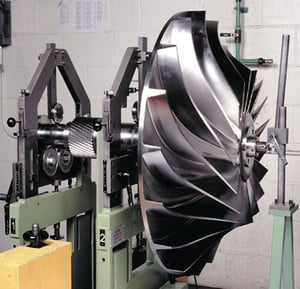
Concepts NREC operates three Schenck dynamic balancing machines with computer control and readout. The largest machine, a Schenck Model H4/CAB500, can balance rotors weighing up to 2,200 lbm. The smallest machine, Schenck Model HT1 B, handles small rotors that fall below the sensitivity range of the larger machines.

Dynamic balance machines include:

Schenck Model CAB690

  • CAB 690H instrumentation
  • Features advanced watt metric measuring system to suppress extraneous vibrations during measurement cycle and provide superior accuracy

Schenck Model H4B

  • CAB 690 instrumentation
  • Diameter capacity, 63 inches (1,600 mm)
  • Weight capacity 2,200 lbm (1,000 kg)

Schenck Model HT1 B

  • CAB 690 instrumentation
  • Diameter capacity 10 inches (254 mm)
  • Weight capacity 10 lbm (4.5 kg)
 

Schenck dynamic balancing machines accommodate impellers from less than one pound up to 2,200 lbs

Overspeed Testing

Concepts NREC maintains two spin pits equipped with air turbines of various sizes and capacities. Rotors up to 34 inches in diameter and 1,500 pounds can be spin tested. Smaller rotors can be tested at speeds up to 150,000 rpm.

Spin pit test equipment includes:

Two Barbour Stockwell Spin Vessels

  • 2-, 4-, 5-, and 6-inch air turbine drives
  • Diameter capacity 34 inches (860 mm)
  • Length capacity 41 inches (1,040 mm)
  • Weight capacity 1,500 lbm (700 kg)
  • At full weight, speeds up to 40,000 rpm
  • For smaller rotors, speeds up to 150,000 rpm
Turbine-driven spin pits provide overspeed testing up to 150,000 rpm

Turbine-driven spin pits provide overspeed testing up to 150,000 rpm

Test Laboratories

Concepts NREC operates extensive performance testing facilities to validate the operating specifications and design objectives of pumps, compressors, and turbines. Each of these facilities can adapt to a wide variety of requirements for evaluating both scale-model prototypes and full-dimension turbomachinery components and complete machines.

Flow, pressure, temperature, and force measurements

Concepts NREC has developed unique rigs for determining the forces and moments on rotating impellers, bearings, seals, couplings, and other components. These rigs provide a full suite of flow, pressure, temperature, and force measurements for an accurate characterization of performance and rotordynamic characteristics.

Concepts NREC's test laboratories contain instrumentation from classical pneumatic and thermal probes and traverses to more sophisticated hot-wire/hot-film and laser anemometers, high-frequency pressure transducers, and proximity probes. Data-acquisition systems, laboratory software, traversing equipment, instrumentation devices (probes), and calibration services for various pressure and temperature probes are all available.

A wide range of test facilities 

Test rigs with advanced instrumentation are available for impellers up to 60 mm, 90 mm, 120 mm, and larger, and include precise pneumatic traversing for high-performance radial flow stages. Concepts NREC’s 9,000-square-foot laboratory facility includes three test chambers, each with complete utilities and acoustic isolation. Within these chambers, a gas-turbine system can drive single-stage compressors up to 1,300 hp at speeds up to 62,000 rpm. A 400 hp hydraulic drive provides variable speeds up to 4,000 rpm. One test chamber with a 10-ton crane and an 8- by 12-foot isolated T-slot plate floor is also a secure assembly area.


NOTARĀ® helicopter fan under test in a custom test rig

NOTAR® helicopter fan under test in a custom test rig
New impeller and crossover design for the LH2 turbopump in the Space Shuttle main engine (SSME) undergoing tests on the magnetic bearing rig in Concepts NREC's hydrodynamics lab

New impeller and crossover design for the LH2 turbopump in the Space Shuttle main engine (SSME) undergoing tests on the magnetic bearing rig in Concepts NREC's
hydrodynamics lab
  • All test chambers have access to recirculated cooling water plus compressed air up to 500 cfm.
  • An ASME standard flow-measurement section above each test chamber is linked to a central data-acquisition system.
  • The central data-acquisition facility can be configured to sequentially scan up to 144 pressures, 40 electrical signals, and 50 temperatures.
  • Ancillary operations include equipment for installing instrumentation into test hardware, ovens for thermal testing and heat-shrink assembly, and an electronics laboratory.

Webinars

Course Preview: Understanding Green Energy
February 9, 2012
10:00 AM EST
Register Now>