E-pumps
Electric driven pumps, often called e-pumps, are becoming more popular for smaller sized rocket propulsion in situations where launch system cost and simplicity are of paramount importance. E-pump design considerations include optimum suction performance, efficiency, weight and cost.
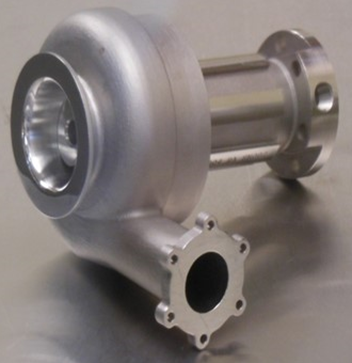
We have an e-pump prototype which has been tested with several propellants and can be customized to run a wide range of head/flow conditions. The pump can be modified with alternate bearings and seals for non-cryogenic service.
This e-pump prototype is currently being used by several clients in development projects for aerospace applications and for cryogenic service in space.
Why e-pumps?
- Simplifies the pump
- No hot turbine
- Speed match between the pump and turbine no longer a concern
- Easier to control the pump speed, and hence where the pump operates
- Eliminates large temperature gradients between the hot turbine and cold pump
- Simplifies the engine
- At current battery energy/power density levels, e-pumps make sense for smaller engines (5-10K lbf thrust)
Concepts NREC has been active in the e-pump arena for 10 years with prior in-depth experience researching and developing conventional rocket turbopumps.
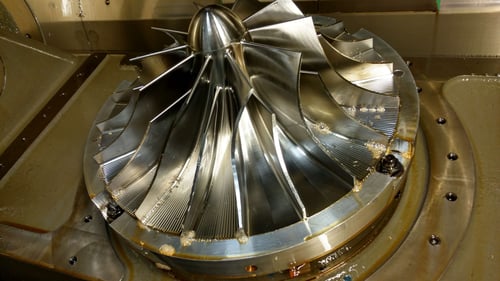
Below is a video of Concepts NREC's optional 3+2 Roughing Module that enables roughing out of impellers using 3-axis algorithms, keeping a constant tool vector. This strategy optimizes the toolpath to provide constant cutting load, making it suitable for high speed machining. This is extremely helpful for large (>0.5 m) diameter impellers and/or hard materials where roughing using the 5-axis strategies is less efficient.
Below is a video of Concepts NREC's optional 3+2 Roughing Module that enables roughing out of impellers using 3-axis algorithms, keeping a constant tool vector. This strategy optimizes the toolpath to provide constant cutting load, making it suitable for high speed machining. This is extremely helpful for large (>0.5 m) diameter impellers and/or hard materials where roughing using the 5-axis strategies is less efficient.
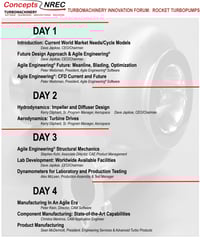
Rocket Turbopump Forum
Receive exclusive access to view 9 hours of recorded discussion from industry experts, engineers and developers on the current state and future of turbomachinery design, manufacture, and testing of rocket turbopump components.