Why Meanline Scripting is Becoming Essential for Turbomachinery Design
Manual meanline design can sometimes feel less like design and more like managing a chain of tiny decisions.


For most turbomachinery engineers, optimization isn’t a new idea. It’s a critical part of their workflow that can’t be overlooked. But sometimes that crucial step isn’t easy to get to.
The question is no longer if engineers should optimize their design, but whether their workflow supports this as a reliable and repeatable step rather than a special-effort exercise. When optimization becomes a baked-in part of the process instead of an occasional one, engineers spend more time in the design space and less time managing the conditions required to get there.
For teams working with complex turbomachinery, that distinction between occasional and repeatable can define the quality of the final design. Getting there consistently is where most workflows fall short.
Well-executed optimization runs are not the same thing as seamless, scalable workflows. The first is a result, while the second is a repeatable process.
There are a lot of factors that go into whether an engineering team commits to making optimization part of their workflow. The overhead has to be low enough that optimization gets used regularly, not pulled out selectively when time and resources align.
A big part of what drives that overhead is how well the tools in a team's environment actually talk to each other. When design tools, optimization platforms, and CFD solvers are tightly connected, the process of setting up and running an optimization becomes something engineers can do without rebuilding the pipeline each time.
Connected tools also change who can run the process. A workflow that depends on deep familiarity with how disparate software environments interact will always be limited to the engineers who have that knowledge. Tighter integration means the process is defined by the workflow itself, not by the person running it, which is what makes it scalable across a team and across projects.
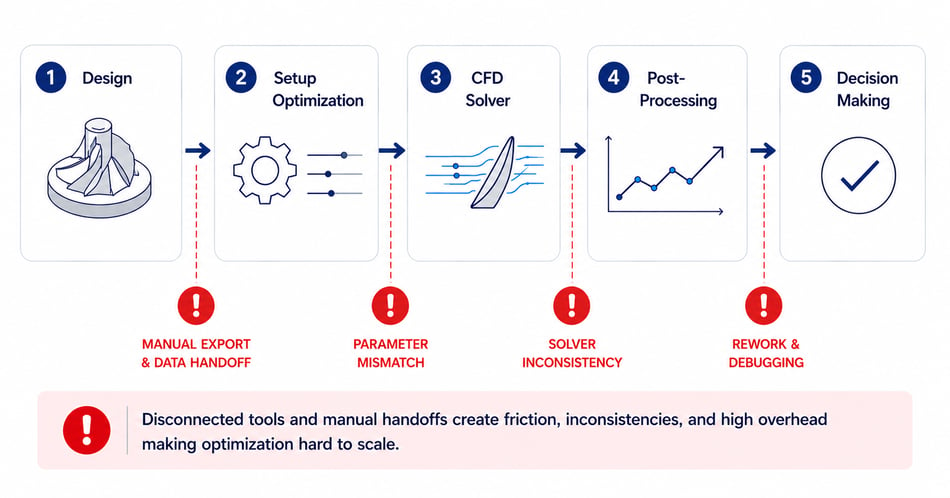
Even teams with strong CAE capabilities and experienced engineers run into the same friction points when trying to make optimization repeatable. The breakdown rarely happens because the tools aren't powerful enough; it happens because the tools weren't designed to work together.
That starts with how design tools connect to optimization platforms. In many CAE environments, that connection is manual or semi-manual, resulting in engineers exporting geometry, configuring inputs, and setting up the optimization problem by hand. There's no inherent link between where the design lives and where the optimization runs.
Another persistent challenge is CFD solver integration. Running a CFD analysis as part of an optimization loop isn't just a matter of connecting software, it means managing mesh generation, solver settings, convergence criteria, and result extraction in a way that's consistent across every iteration. When that process isn't automated and validated, small inconsistencies compound quickly. An optimization loop that requires manual intervention between runs isn't really automated, and the overhead of managing it pushes teams back toward running optimization selectively rather than routinely.
Maintaining coherence across software environments compounds the problem.
Turbomachinery design typically involves multiple tools handling different parts of the process — geometry, meshing, simulation, post-processing — and keeping those environments synchronized is an ongoing effort. Issues arise when data formats change between handoffs, parameters defined in one tool don't map cleanly to another, and when something breaks or produces unexpected results. Diagnosing where in the chain the problem occurred takes time.
Together, these friction points create a workflow that works in controlled conditions but becomes unreliable at scale. The result is that optimization stays a high-effort exercise rather than a default step.
The friction engineering teams feel isn’t inevitable. It is a symptom of workflows that weren't built with integration in mind. When that changes, the difference shows up immediately.
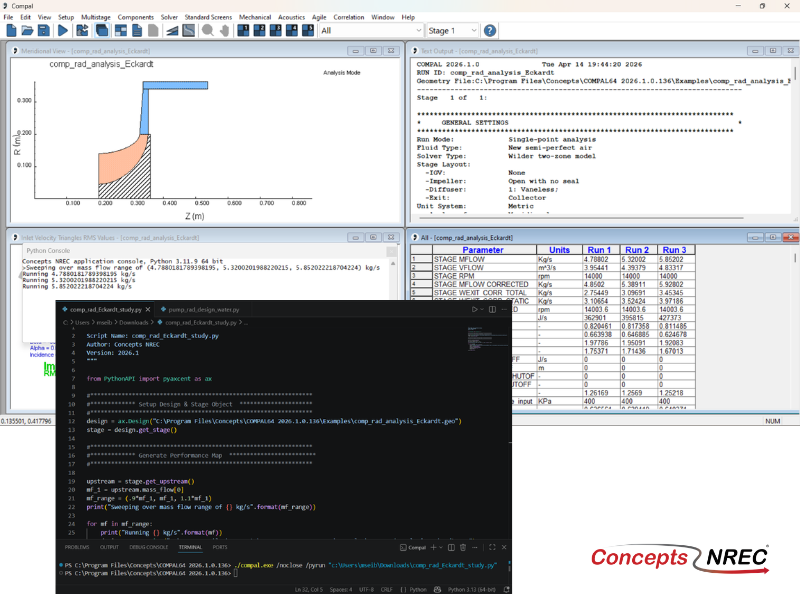
A well-integrated optimization workflow doesn't require engineers to rebuild the connection between tools every time. Design parameters flow into the optimization environment without manual export. The CFD solver is opened automatically, runs consistently, and returns results in a format the optimization platform already understands. What may have taken hours of configuration becomes a process that starts in minutes and - more importantly - starts the same way every time.
That consistency is what makes the other outcomes possible. When variables are defined once in a central configuration and passed through the workflow automatically, parameters stay consistent from run to run and across engineers. Additionally, handoff errors become less frequent because there are fewer manual handoffs where things could go wrong.
A workflow built on tight integration also allows more of the team to contribute. When the process itself defines how tools connect and how variables are translated, running an optimization study doesn't require deep familiarity with every tool in the chain. Engineers earlier in their career can execute studies that would previously have required senior oversight.
The right optimization and turbomachinery CAE tools that are designed with this kind of integration in mind make each of these outcomes significantly easier to achieve.
When there is less manual effort, the nature of optimization changes. It stops being a late-stage design validation and becomes something engineers reach for earlier and more often, which means more of the design space gets explored before decisions get locked in.
For turbomachinery teams, that shift has real consequences. Complex components that previously got one or two optimized designs might now get dozens. Project timelines also tighten not because engineers are working faster, but because the process to get from idea to validated result is smoother.
The gap between a workflow that works once and one that scales isn't a tools problem or a talent problem; it's largely an integration problem. What's missing for most teams is the connection between the tools that makes optimization accessible enough to use routinely.
If these friction points sound familiar, it's worth seeing how tighter integration between optimization and CAE tools addresses them directly, and what that looks like in practice. It’s more achievable than most teams think.

Tags: CAE Software, Software, Optimization
Manual meanline design can sometimes feel less like design and more like managing a chain of tiny decisions.
It’s no secret that turbomachinery design has been one of the most demanding CAE environments, thanks to tight tolerances, complex physics, and long design cycles. That hasn’t changed in 2026, but...