Manual meanline design can sometimes feel less like design and more like managing a chain of tiny decisions.
Engineers begin with a set of target conditions, but even small design changes often require manually updating, recalculating, and validating multiple parts of the model before iteration can continue.
Over time, those repetitive interactions become a bottleneck. Meanline analysis remains one of the most important early stages of turbomachinery design because it provides valuable insight into machine performance, but manually driving the workflow limits how quickly engineers can iterate and how much of the design space they can realistically explore.
This is where scripting in meanline turbomachinery design can fundamentally change the workflow.
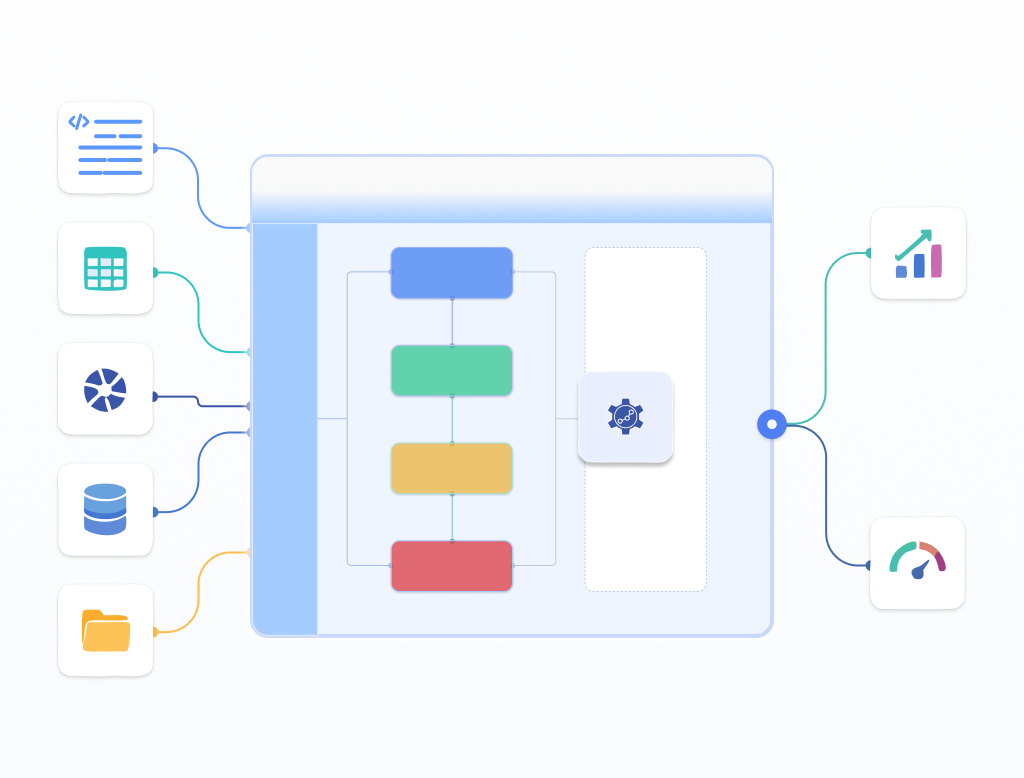
By utilizing seamless scripting APIs, engineers can automate repetitive tasks, easily enable parametric sweeps, and connect their meanline tool into larger design and automation processes. Rather than replacing engineering expertise, scripting extends it, allowing teams to iterate faster, evaluate more design possibilities, and build more scalable turbomachinery design processes.
Control Your Meanline Solver at Scale with Scripting
At it’s core, scripting is a way of turning a manual process into an automated one. By using scripting languages such as Python, MATLAB, and others, engineers can write small pieces of code that control how tasks are executed within a meanline solver. Instead of manually clicking through the same steps over and over, a script tells the software:
-
what inputs to change
-
what calculations to run
-
what results to extract
-
what to do next
The difference isn’t just convenience, it's scale.
A scripted workflow allows the solver to evaluate multiple cases systematically, making it possible to explore broader regions of the design space, compare trends across operating conditions, and automate repetitive iteration work, setting up the design for deeper optimization later in the workflow.
Key Benefits of Scripting in Meanline Turbomachinery Design
While scripting in meanline design is not new, many engineering teams still underuse it.
Some are stuck in legacy workflows that have never used scripting, while others rely heavily on experience and intuition. But as turbomachinery designs become more complex, engineers who integrate scripting into their workflow can take advantage of the key benefits of scripting in meanline turbomachinery design.
1. Explore More of the Design Space
The more design iterations engineers can evaluate, the more insight they have into how the machine behaves across operating conditions.
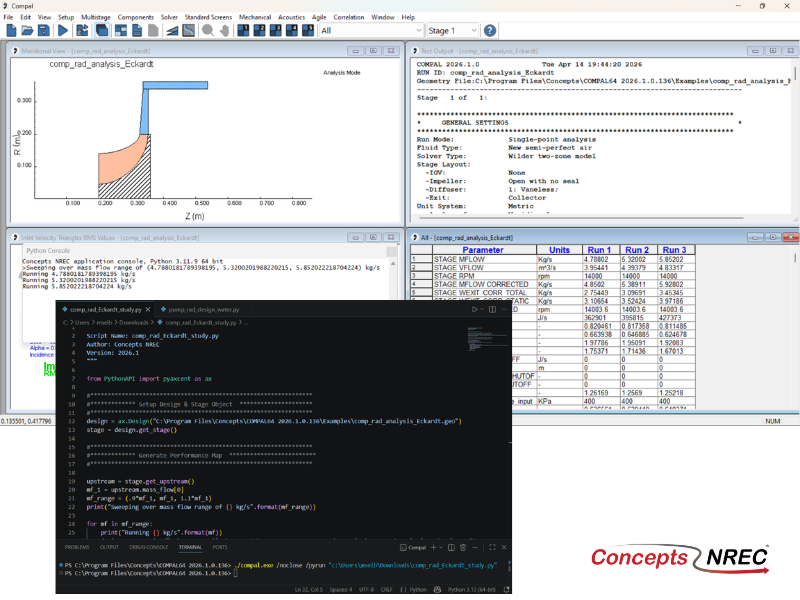
With a scripting API, you can sweep across multiple input variables automatically. This makes it possible to generate performance maps across a range of operating conditions without relying on manual data re-entry.
2. Accelerate Meanline Model Tuning
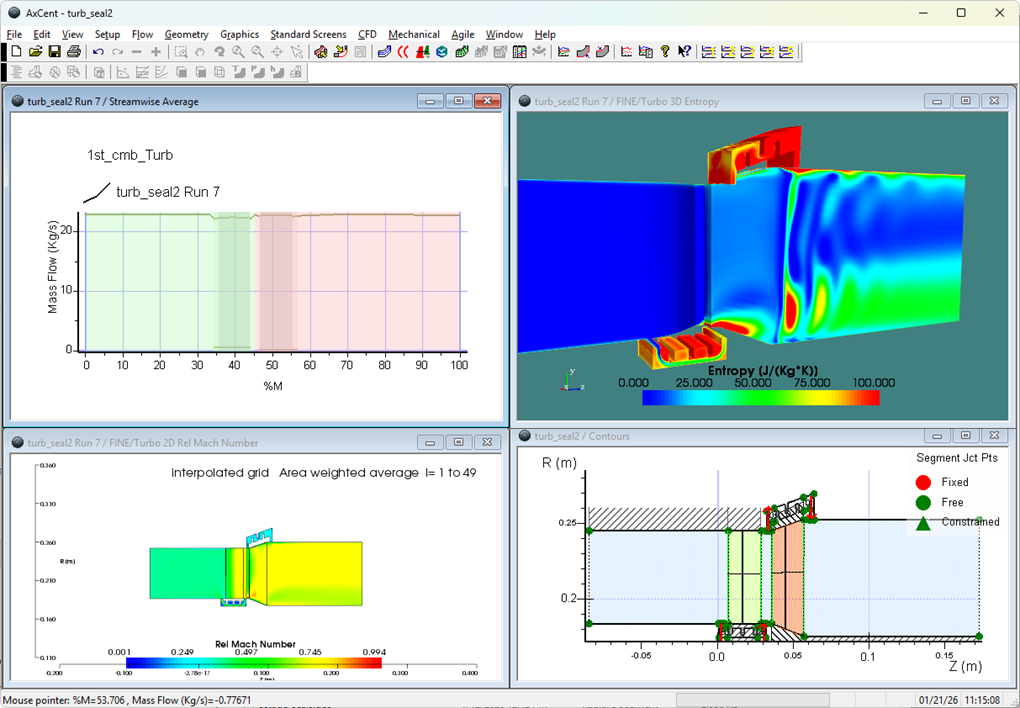
Scripting can help accelerate the process of tuning meanline models to better align with CFD results.
Consider a typical workflow: a preliminary meanline design is created around a target operating point. The design is then transferred into a 3D design environment and evaluated using CFD. Those results are compared against the original meanline predictions. Engineers can then adjust meanline modeling parameters to more accurately reflect the CFD analysis thus enabling further meanline design work.
Much of this comparison and iteration process can be automated through scripting, reducing the time required to reconcile 1D and 3D results in order to improve confidence in the preliminary design model. Engineers can systematically adjust tuning parameters, rerun cases, compare trends, and continue refining the design across a performance map before returning to CFD for final refinement.
Tuning your meanline models to CFD results make the meanline designs more accurate and allow deeper development that will yield stronger machine designs at the 3D stage.
3. Automate Optimization
Scripting also allows engineers to transition from manual iteration into automated optimization by systematically searching for improved designs instead of adjusting parameters one point at a time.
Scripts can define objective functions such as efficiency, pressure ratio, or operating range performance, then automatically iterate through design variations to identify better performing solutions.
This approach dramatically reduces the time it takes to find an optimized design. Instead of relying on a limited number of hand-selected iterations, engineers can evaluate large regions of the design space in a structured and repeatable way.
Once a strong preliminary design space has been established, it can serve as the foundation for advanced optimization environments involving broader multi-variable and multidisciplinary studies.
4. Reduce Work Downstream
The impact of scripting also extends well beyond the meanline environment.
In many turbomachinery workflows, a significant amount of engineering time is spent moving data between tools, reorganizing outputs, and preparing results for the next stage of analysis. Scripting helps eliminate much of that manual work by allowing meanline outputs to feed directly into downstream applications and processes.
Instead of manually transferring data between applications, scripts can automatically pass geometry, operating conditions, and performance data to the next step. This reduces repetitive data entry, minimizes the risk of transcription errors, and creates more connected end-to-end design pipelines.
Scripting also allows engineers to build custom post-processing workflows tailored to their needs. Results can be automatically visualized, exported into preferred formats, or used to generate custom calculated outputs specific to a team’s internal analysis methods or reporting requirements.
Getting Started with Scripting in Your Meanline Design Software
In many cases, the most effective way to begin implementing scripting is by starting with a small, repetitive task that already consumes engineering time, such as automating a single parametric sweep or setting up a custom template for those designs that are specific to you and your company. It can also be helpful to validate scripts against known cases to ensure results remain accurate and repeatable.
From there, workflows can gradually expand from simple automation into broader design exploration, optimization, and workflow integration.
As scripts become more integrated into the design process, documenting workflows clearly and using version control becomes increasingly important for maintaining consistency and repeatability across projects.
Why Scripting Is Becoming a Competitive Requirement
Meanline scripting is becoming less of a specialized capability and more of a practical requirement for teams trying to move faster through increasingly complex design workflows.
By automating repetitive iteration, connecting tools more efficiently, and enabling broader design exploration, scripting allows engineers to spend less time managing workflows and more time evaluating performance tradeoffs and refining designs.
Rather than manually managing setup, data transfer, and repetitive recalculation work, engineers can focus on building stronger preliminary designs and making better-informed decisions earlier in the development cycle. Over time, that shift creates meaningful advantages in both engineering efficiency and design quality.