CAE Software for Radial Fans
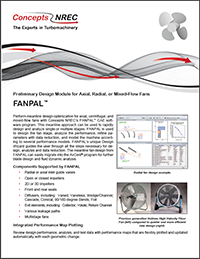
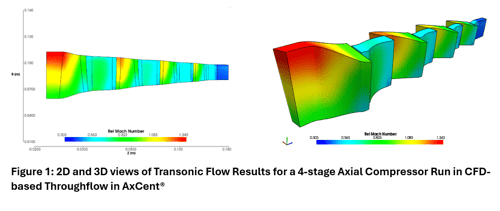
A meanline approach is used to design axial, radial, and mixed-flow fans, both for single and for multiple stages. Use FANPAL™ to design the stage, analyze the performance, refine parameters with data reduction, and model the machine according to several performance models. FANPAL’s unique Design Wizard leads the user through all the steps necessary for design, analysis, and data reduction. The meanline fan design from FANPAL can easily migrate into the AxCent® program for further blade design and fluid dynamic analysis.
Components Supported by FANPAL:
- Radial or axial inlet guide vanes
- Open or closed impellers
- 2D or 3D impellers
- Front and rear seals (multiple)
- Diffuser types, including…
- Vaned
- Vaneless
- Wedge/channel
- Cascade
- Conical
- 90/180 degree bends
- Foil
- Exit elements, including…
- Collector
- Volute
- Return channel
- Various leakage paths
- Multistage fans
Modeling
Radial fans and blowers in FANPAL are supported by the two-elements-in-series (TEIS) rotor diffusion model using a two-zone approach. Axial designs are modeled using the famous Koch-Smith method to calculate loss and deviation. Other models are implemented to calculate disk friction, exit mixing, radial and axial stator diffusion/losses, volutes, stall, thrust, and other fundamental fluid dynamic aspects of fan performance.
Integrated Performance Map Plotting
Review design performance, analysis, and test data with performance maps that are flexibly plotted and updated automatically with each geometric change.
Easy Editing
View the fan or blower stage in an active, true-scale meridional view. Edit the parameters by double clicking on the component in the meridional view. Also edit parameters using a single text input/output file, a feature especially useful for optimization.
Tabular View of Results
View the results in a flexible, spreadsheet-like table, customizable through separate filters. Create any number of filters, select what to display, and customize the labels as well.
Axial View with Velocity Triangles
View blades and velocity triangles at the impeller inlet and exit in a window view.
OLE Automation Support
Control FANPAL from an external program through industry-standard Object Linking and Embedding (OLE) automation. OLE automation supports full control of data entry, program execution, and result retrieval. External programs can be written in Visual Basic, C++, FORTRAN, or any other language that supports the Microsoft® OLE standard.
Text Input / Output
Edit key parameter variables using a single text input/output file. This feature is especially useful for optimization.
Multistage Capability
FANPAL supports multistage analysis and data reduction and provides a variety of multistage performance maps.
Preliminary Mechanical Analysis
FANPAL provides the user with an initial calculation of the design’s mechanical properties. It also rapidly estimates stress, vibration, and fatigue limit, and accesses a large database of customizable material properties.
A Real Fluid Program
FANPAL calculates Real Fluid properties using optional DB Robinson Real Fluid Properties, NIST, or ASME Steam routines. Users can also incorporate their own proprietary fluid properties.
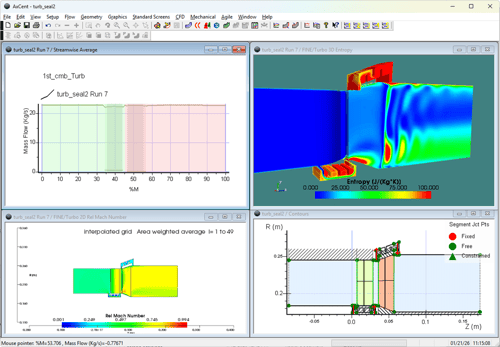
Direct Integration with AxCent®
Start AxCent automatically from FANPAL, with the initial geometry transferred automatically to AxCent. Changes in AxCent that affect the meanline analysis will cause the meanline analysis to be rerun and all performance maps to be regenerated.